
All about Paper M3
Paper M3 Basics
Date: 8 and 9 March 2027
Length: Paper M3 lasts 7.5 hours in total and consists of three parts, each lasting between two and three hours. (IPREE Rule 25(5))
Part 1 in 2027: 2 h 50 minutes
Part 2 in 2027: 2 h 20 minutes
Part 3 in 2027: 2 h 20 minutes
Start time: 9:30 CET
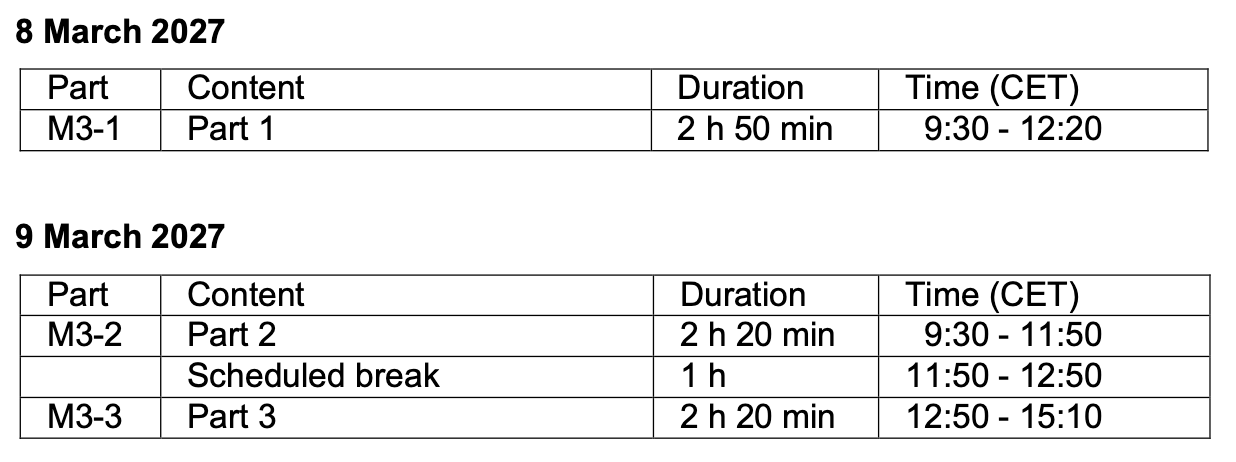
Schedule in 2027
Topic: M3 will be a hard exam! It will test the topics of the old Paper A, B and C exams, but will not be limited to exactly the same scenarios, e.g. the defending exercise can be drafting an appeal, and instead of drafting an opposition, part 3 can also be about writing third party observations.
According to the REE ("Regulation on the European qualifying examination for professional representatives"), Art.1(5)(d):
“Paper M3 assesses whether the candidate can assess, draft and develop patent documentation and submissions, based on documents and instructions from the client. It consists of three parts, each requiring a free-text answer:
(i) Part 1 of paper M3 requires at least the drafting of claims.
(ii) Part 2 of paper M3 requires the candidate to develop and present arguments showing why the invention and the application or patent comply with the requirements of the EPC or the PCT, and to amend claims if necessary.
(iii) Part 3 of paper M3 requires the candidate to develop and present arguments showing why the invention and the application or patent do not comply with the requirements of the EPC or the PCT.”
Syllabus: According to IPREE Rule 25(6), candidates are expected to be familiar with at least the documents listed in Rule 21(1).
IPREE Rule 21(1): Unless otherwise provided, candidates are expected to be familiar with at least the following documents in the versions valid as at 31 October of the year prior to the examination:
(a) the EPC
(b) the Implementing Regulations to the EPC
(c) the Protocol on the Centralisation of the European Patent System and on its Introduction (Protocol on Centralisation)
(d) the Protocol on Jurisdiction and the Recognition of Decisions in respect of the Right to the Grant of a European Patent (Protocol on Recognition)
(e) the Rules relating to Fees
(f) the notice of the President of the EPO concerning the arrangements for deposit accounts
(g) the PCT
(h) the Regulations under the PCT
(i) the PCT Applicant's Guide
(j) the Paris Convention for the Protection of Industrial Property
(k) the lists of EPC contracting states, extension states and validation states, of contracting states to the PCT and of states which have ratified the Agreement on a Unified Patent Court
(l) National law relating to the EPC, as published by the EPO
(m) the Guidelines for Examination in the EPO
(n) the content of the Official Journal of the EPO
(o) the Guidelines for Search and Examination at the EPO as PCT Authority
(p) National measures relating to the Unitary Patent, as published by the EPO
(q) the following regulations relating to the Unified Patent Court:
Articles 1 to 4, 24 to 34, 47, 48, 66, 83 and 89 of the Agreement on a Unified Patent Court;
Rules 5, 5A and 85 to 98 of the Rules of Procedure of the Unified Patent Court
(r) the Case Law Book, as defined in Rule 2
(s) Code of Conduct of the Institute of Professional Representatives before the European Patent Office
(t) Regulation on discipline for professional representatives.
Threshold for passing: Between 30% and 60% of the total achievable marks (see IPREE Rule 6(6)(a)(ii)) in all parts (we don’t know the exact passing threshold before the exam). In order to pass M3, all three parts have to be passed separately in one sitting (see IPREE Rule 6(4)).
Documents that can be printed: ⚠️ There is an important change in the EQE 2027: No part of any examination paper will be made available to candidates in advance as a printable document.

Paper M3 - Part 1 (Drafting) study groups with Maryna Welsch
Part 1 - Course 1: 28-29 November 2026
Saturday: 10:00 - 12:00; 13:00 - 15:00
Sunday: 10:00 - 12:30; 13:30 - 16:30
Part 1 - Course 2: 16-17 January 2027
Saturday: 10:00 - 12:00; 13:00 - 15:00
Sunday: 10:00 - 12:30; 13:30 - 16:30
We are so happy to be able to offer two-day courses for each part of the new M3 exam. Maryna Welsch, who you might know from Fillun meetups, will offer a course for Parts 1 and 2 in both 2026 and 2027, and Zsofia will offer short courses for Part 3. You can join any of the courses, even for only one part. You are also free to combine them in any way you like.
Maryna attended Zsofia’s 6-month Paper D1 study group and used the Fillun methodology when preparing for the other Papers too. She passed all the EQE exams in 2025 at her first sitting. Maryna has been actively involved in the preparation of the new M3 example papers, giving her first-hand insight into the expectations and challenges of the new exam.
The study plan for Maryna’s courses is as follows: on the first day of the courses, you will focus on methodology and work through examples from past papers, learning how to recognize the examiners' wording and what they are actually looking for in the answers.
On the second day, you will work together on a mock paper that Maryna created specifically for you.
The courses will be offered only twice, to small groups of candidates, and will take place via Zoom.
Paper M3 courses
Paper M3 - Part 2 (Defending) study groups with Maryna Welsch
Part 2 - Course 1: 5-6 December 2026
(fully booked)
Part 2 - Course 2: 30-31 January 2027
Saturday: 10:00 - 12:00; 13:00 - 15:00
Sunday: 10:00 - 12:30; 13:30 - 16:30
We are so happy to be able to offer two-day courses for each part of the new M3 exam. Maryna Welsch, who you might know from Fillun meetups, will offer a course for Parts 1 and 2 in both 2026 and 2027, and Zsofia will offer short courses for Part 3. You can join any of the courses, even for only one part. You are also free to combine them in any way you like.
Maryna attended Zsofia’s 6-month Paper D1 study group and used the Fillun methodology when preparing for the other Papers too. She passed all the EQE exams in 2025 at her first sitting. Maryna has been actively involved in the preparation of the new M3 example papers, giving her first-hand insight into the expectations and challenges of the new exam.
The study plan for Maryna’s courses is as follows: on the first day of the courses, you will focus on methodology and work through examples from past papers, learning how to recognize the examiners' wording and what they are actually looking for in the answers.
On the second day, you will work together on a mock paper that Maryna created specifically for you.
The courses will be offered only twice, to small groups of candidates, and will take place via Zoom.
Paper M3 - Part 3 (Attacking) study groups with Zsofia
Part 3 - Course 1: 16-17 December 2026
(fully booked)
Part 3 - Course 2: 5-6 January 2027
(fully booked)
Self-paced Paper M3 course
(All three parts: Drafting, defending, attacking)
Your complete, self-paced blueprint for passing every part of Paper M3. Ideal if you prefer to study on your own schedule, giving you full control to pause, rewind, and master the material at whatever pace works best for you.
This master course includes all 10 videos and 21 PDFs from our Paper M3 Part 1, Part 2 and Part 3 courses, as well as all materials from our 2025 Paper A, 2025 Paper B and 2019 Paper C courses.
By purchasing this product, you will obtain:
10 videos:
Introduction video (33 minutes)
Drafting basics and methodology (1 h 10 minutes)
2025 Paper A analysis (1 h 13 minutes)
Defending basics, legal background and methodology (2 videos, altogether 2 h 30 min)
2025 Paper B analysis (1 h 52 minutes)
Attacking basics, legal background and methodology (3 videos, altogether 4 h 15 minutes)
2019 Paper C analysis (2 h 16 min)
21 PDFs:
Introduction slides
Drafting basics and methodology slides
Part 1 example case (and its solution)
Part 1 template
2025 Paper A analysis & claims
2025 Paper A annotated text
Defending basics and methodology slides
Part 2 example case (and its solution)
Part 2 template
Part 2 methodology steps
2025 Paper B analysis & claims
2025 Paper B annotated text
Attacking basics and methodology slides
Effective date + prior art table
Overview table and legal basis of all attacks
Part 3 example case (and its solution)
Part 3 template
Part 3 methodology steps
2019 Paper C analysis & claims
2019 Paper C annotated text
2019 Paper C filled attack table
The videos were recorded in 2026.
Tutor: Zsofia Pintz
Please note that the downloadable file only contains the PDF materials. The videos will be sent manually, shortly after your purchase.
The price includes VAT and the card processing fee.
This Paper M3 Base course covers all parts (drafting, defending and attacking), but the past exam analysis videos are not included in this package.
By purchasing this product, you will obtain:
7 videos:
Introduction video (33 minutes)
Drafting basics and methodology (1 h 10 minutes)
Defending basics, legal background and methodology (2 videos, altogether 2 h 30 min)
Attacking basics, legal background and methodology (3 videos, altogether 4 h 15 minutes)
14 PDFs:
Introduction slides
Drafting basics and methodology slides
Part 1 example case (and its solution)
Part 1 template
Defending basics and methodology slides
Part 2 example case (and its solution)
Part 2 template
Part 2 methodology steps
Attacking basics and methodology slides
Effective date + prior art table
Overview table and legal basis of all attacks
Part 3 example case (and its solution)
Part 3 template
Part 3 methodology steps
The videos were recorded in 2026.
Tutor: Zsofia Pintz
Please note that the downloadable file only contains the PDF materials. The videos will be sent manually, shortly after your purchase.
The price includes VAT and the card processing fee.
Self-paced Paper M3 course
(Part 1 - Drafting)
By purchasing this product, you will obtain:
2 videos:
Introduction video (33 minutes)
Drafting basics and methodology (1 h 10 minutes)
4 PDFs:
Introduction slides
Drafting basics and methodology slides
Part 1 example case (and its solution)
Part 1 template
The videos were recorded in 2026.
Tutor: Zsofia Pintz
Please note that the downloadable file only contains the PDF materials. The videos will be sent manually, shortly after your purchase.
The price includes VAT and the card processing fee.
By purchasing this product, you will obtain:
3 videos:
Introduction video (33 minutes)
Drafting basics and methodology (1 h 10 minutes)
2025 Paper A analysis (1 h 13 minutes)
6 PDFs:
Introduction slides
Drafting basics and methodology slides
Part 1 example case (and its solution)
Part 1 template
2025 Paper A analysis & claims
2025 Paper A annotated text
The videos (except for the 2025 Paper A analysis) were recorded in 2026.
Tutor: Zsofia Pintz
Please note that the downloadable file only contains the PDF materials. The videos will be sent manually, shortly after your purchase.
The price includes VAT and the card processing fee.
Self-paced Paper M3 course
(Part 2 - Defending)
By purchasing this product, you will obtain:
3 videos:
Introduction video (33 minutes)
Defending basics, legal background and methodology (2 videos, altogether 2 h 30 min)
5 PDFs:
Introduction slides
Defending basics and methodology slides
Part 2 example case (and its solution)
Part 2 template
Part 2 methodology steps
The videos were recorded in 2026.
Tutor: Zsofia Pintz
Please note that the downloadable file only contains the PDF materials. The videos will be sent manually, shortly after your purchase.
The price includes VAT and the card processing fee.
By purchasing this product, you will obtain:
4 videos:
Introduction video (33 minutes)
Defending basics, legal background and methodology (2 videos, altogether 2 h 30 min)
2025 Paper B analysis (1 h 52 minutes)
7 PDFs:
Introduction slides
Defending basics and methodology slides
Part 2 example case (and its solution)
Part 2 template
Part 2 methodology steps
2025 Paper B analysis & claims
2025 Paper B annotated text
The videos (except for the 2025 Paper B analysis) were recorded in 2026.
Tutor: Zsofia Pintz
Please note that the downloadable file only contains the PDF materials. The videos will be sent manually, shortly after your purchase.
The price includes VAT and the card processing fee.
Self-paced Paper M3 course
(Part 3 - Attacking)
By purchasing this product, you will obtain:
4 videos:
Introduction video (33 minutes)
Attacking basics, legal background and methodology (3 videos, altogether 4 h 15 minutes)
7 PDFs:
Introduction slides
Attacking basics and methodology slides
Effective date + prior art table
Overview table and legal basis of all attacks
Part 3 example case (and its solution)
Part 3 template
Part 3 methodology steps
The videos were recorded in 2026.
Tutor: Zsofia Pintz
Please note that the downloadable file only contains the PDF materials. The videos will be sent manually, shortly after your purchase.
The price includes VAT and the card processing fee.
By purchasing this product, you will obtain:
5 videos:
Introduction video (33 minutes)
Attacking basics, legal background and methodology (3 videos, altogether 4 h 15 minutes)
2019 Paper C analysis (2 h 16 min)
10 PDFs:
Introduction slides
Attacking basics and methodology slides
Effective date + prior art table
Overview table and legal basis of all attacks
Part 3 example case (and its solution)
Part 3 template
Part 3 methodology steps
2019 Paper C analysis & claims
2019 Paper C annotated text
2019 Paper C filled attack table
The videos were recorded in 2026.
Tutor: Zsofia Pintz
Please note that the downloadable file only contains the PDF materials. The videos will be sent manually, shortly after your purchase.
The price includes VAT and the card processing fee.
Part 1 - Drafting
Claims
In the official Mock M3 paper, an independent claim (40 marks), 5 dependent claims (40 marks), and a short introduction (20 marks) need to be drafted.
In the old Paper A exams, candidates had to draft 15 claims. (The claims above 15 were not marked.)
However, regardless of how many claims have to be drafted, the goals and requirements are the same. (The possible deduction noted in the below list was the situation in the Paper A exam, but I kept the notes as it can be a good indication how important that requirement is.)
The drafted claims must:
be novel,
If a claim is obviously not novel over the prior art provided in the exam, you might not get any marks for the claim.be inventive,
If a claim is not inventive, you can lose 50% or more of the available marks.be clear,
For each clarity problem you can lose some points. Altogether, lack of clarity can lose you up to about 50 percent of the marks available for that claim.be unitary,
include all essential features,
If you don’t add an essential feature to the independent claim, the claim will be heavily penalised. These features are usually described by the client with words like “must”, “is” “involves”, “has”, “required”, “essential”, “always”, etc. The optional features are usually described by the client with words like “may”, “might”, “can”, “preferred”, “optionally”, “normally”, “such as “.still be as broad as possible,
Major unnecessary limitations will cost you a lot (50-75% of the available marks for a claim can be deducted), while minor unnecessary limitations are generally penalised less severely (33-40% of the marks can be lost).cover all embodiments mentioned by the client,
All embodiments described by the client have to be covered by the independent claims as a whole, it usually must be done via a single independent product claim. (A good practice for this is 2013 Paper A E/M). Best fall-back positions and the products that the client wants to commercialise should be in dependent claims. Usually, the embodiments illustrated in the Figs. should also be defined in dependent claims.have correct dependencies.
Do not always refer back only to claim 1, and do not simply refer back always to “any of preceding claims”. In the old Paper A exams at least, there were always features that were not compatible, so candidates had to be careful with the dependencies.
The goal is to provide the best possible scope of protection, that is also novel and inventive. To pass the EQE, candidates have to draft a claim that could go through to grant; not the type of claim we draft for clients in real life. We also have to follow the client’s wish, you will be told what they wish to protect (or sell, etc.).
You cannot get minus points for a claim in total.
In the Paper A exams, using two-part form was not a must as long as candidates stated the differences from the prior art in the description, it will likely be the same in M3.
Do not create new terms for the invention. You can simply copy (literally copy - Hurrah online EQE!) the expressions from the client’s letter. Really, there is no need for thinking of new names for the features, you will not only lose time but confuse the marker who corrects your exam.
Also, look for language in the client’s letter that looks like a claim (“we are thinking of a method of manufacturing our device…”), you might be able to use it for an(other) independent claim.
And finally, do not overcomplicate the claims. Each word in excess of the minimum necessary could lose marks, and also makes it more difficult to mark your claim.
Introductory part of description
As mentioned above, you will also have to draft an introduction in the first part of the M3 exam. In the official EPO Mock M3, it is also stated that “the introduction must contain no more than 2000 characters (ca. 320 words).” You can expect the same (or something very similar) in the M3 exam. It’s important to follow this instruction, as the published answer to the mock clarifies: “Candidates exceeding the specified character count were not awarded full marks.”
In the introduction, you have to describe (some of it you can copy-paste from the client’s letter) the:
Technical field, i.e. define the subject-matter
Differences from the prior art, i.e. explain the invention in light of the prior art and the differences (discuss all prior art: D1, D2, etc)
Technical problem solved by the invention (in the mock, the problem solved is the disadvantage of the prior art)
Solution - more details of the invention according to the independent claim (“The application addresses this problem by providing…” then repeat the features of the claim, and finally explain the solution in 2-3 sentences.)
Part 2 - Defending
Part 2 will likely relate to the same (or very similar) invention as Part 1 of M3. Part 2 is about amending the claims and drafting an accompanying argumentation (for example response to office action or appeal) to the EPO.
30 marks are available for the claim amendments and 70 marks are available for the arguments (just like in the Paper B exams).
Amended claims
The client guides you
In the EQE, it is very important to respect the client’s wishes. For example, if they want to keep a claim, you should try to save it (if possible). If they mention that a product is commercially important, a dependent claim covering that product might be necessary. The client knows the technology, the prior art and if their invention is novel and inventive. However, the client does not know EPC (or PCT), so they might make a wrong assessment regarding amendments (Art.123(2) EPC), clarity (Art. 84 EPC) or other topics. You, the representative have to know the EPC (and PCT) and amend the claims accordingly.In the official mock M3 exam, the client writes “In our view, the idea of the invention of storing the heat of fusion by melting a salt composition was not duly considered”. With this, the client points the candidate in the right direction, i.e. which features to include, which embodiment to focus on.
Check the office action/decision
The office action/refusal might not always be completely correct (e.g. there were Paper B exams where clarity objections were not correct and candidates had to argue against them), so make sure to check the objections before blindly amending the claims. However, novelty and inventive step arguments are usually correct.Avoid unnecessary restrictions
Similarly to the drafting part of M3, the broadest scope possible should be obtained.Don’t overcomplicate and mess up the terms
Furthermore, similarly to the drafting part of M3, the terms from the original patent application and claims can and should be used. New terminology should be avoided. Using new words for the different features can easily cause Art.123(2) problems!Check and correct the dependency of the claims.
It is usually not necessary to add new dependent claims (unless the client mentions this).
According to the EPO’s Guide to Paper B, it is unlikely (but not impossible) that any suitable amendment will be found entirely in the original claims. A suitable amendment that has a clear technical effect will be hidden in the patent application as originally filed.
Arguments
70% of the marks is for the arguments, so please make sure you leave enough time to write them.
Amendments – Art. 123(2) EPC
Explain the amendments made to all claims and identify the basis in the application as filed, arguing why the amendments comply with Art. 123(2) EPC.Clarity - Art.84 EPC
Explain how the amended claims overcome any clarity objections raised in the office action/refusal. If no objections were raised, make sure that any new amendments still comply with Art. 84 EPC.
(Sometimes the office action/refusal does not raise any clarity objections, but your knowledge about clarity is still tested: e.g. the client wants to add something that is unclear, so you have to be careful and change it.)Novelty - Art.54 EPC
Arguing why the amended claims are novel over the prior art. A detailed argument is expected for each independent claim.Inventive step - Art.56 EPC → Usually, this brings most of the marks
Describing what the closest prior art is and applying problem-solution approach step-by-step for each independent claim. Don’t miss any step of the problem-solution approach (closest prior art, difference, technical effect, objective technical problem, etc.), as each step gains marks.
In your argument, answer these questions:
- Would the skilled person arrive at the subject matter of the claim by considering the teaching of the closest prior art on its own?
- Would the skilled person consider combining the teaching of the closest prior art with that of other prior art documents in order to solve the objective technical problem?
- If the skilled person were to combine the teaching of the closest prior art with other items of prior art, would they arrive at the subject matter of the claim?And of course, address any other objections that are raised, such as unity and R.43(2) EPC.
Part 3 - Attacking
Part 2 will likely relate to the same (or very similar) invention as Part 1 and Part 2 of M3.
In my opinion, Part 3 can be the most different from the old exams, since instead of being limited to the grounds of opposition under Art. 100 EPC, you might be able to use Art. 82, Art. 84, R.43(2) EPC and, when filing Third Party Observations after grant, even Art.123(3) EPC. However, most points will still be available for novelty and inventive step attacks.
Claims to be attacked:
Please always make sure to check the claims whether there are any “or” or “and/or”. An “or” means more embodiments, thus you can expect more attacks than the number of claims.
For example:
Claim 1: Product X.
Claim 2: Product X according to claim 1, wherein X comprises Y and/or Z.
Claim 3: Product X according to claim 1, wherein X comprises W.
Claim 4: Product X according to claim 1 or 3, wherein X is something.
In this case, you might have thought - before preparing for the attacking part - that these are 4 claims, so 4 attacks are required, but in fact, this claim set includes 7 different versions, so 7 attacks will be required:
1. Claim 1,
2. Claim 2+1 comprising Y
3. Claim 2+1 comprising Z
4. Claim 2+1 comprising Y+Z
5. Claim 3+1
6. Claim 4+3+1
7. Claim 4+1
It is very important that all of these 7 versions can have different effective dates and different closest prior arts. It can also happen that the three alternatives of claim 2 have three completely different attacks (one added subject matter, one novelty and one inventive step).
When you read the claims, you should also look for important phrases, such as “comprises” or “consists of”. Also circle/underline any non-technical (e.g. “coloured design” on the cup like in 2007 Paper C), optional (“preferably”, “for example”, “more particularly”), unclear or relative terms (“strong”, “thin” or “hot”) and “for” (“for” normally means “suitable for” except in first and second medical use claims). You will need to look for definitions how to understand the relative terms, otherwise it might be that you can interpret them broadly or disregard them in an inventive step attack (if you do, you still have to mention why you can disregard it!). When it comes to optional terms, they do not have any limiting effect, so the feature following that word is optional (you still have to explain in your answer why you can disregard it!).
The features in the claims will have their technical effects explicitly mentioned in A1, you will always have to cite it (and provide the paragraph number from A1) in the problem-solution approach.
Effective dates and prior art documents:
The client’s letter will help you analyse the priority situation, will include any information about added subject matter as well.
You have to be careful when comparing the content of the different documents. When comparing the content of the priority application and the filed version of A1, you are checking the effective date of the claims. When comparing the content of the filed version and the granted version, you are trying to figure out if there is an Art.123(2) EPC attack.
Then, going through the dates of the Annexes, you will be able to decide which prior art can be used against which claims. It often happens that there are documents that can be used against only some of the claims. Furthermore, same document may be an Art. 54(2) and (3) at the same time for different claims. There might be some PCT or EP documents that are Art.54(3) documents for at least some of the claims. If there are any prior art documents with the same applicant as A1, check whether it is the first application, because it might mean that the priority is invalidly claimed for at least some claims. You should summarize the documents and their usability in your answer, since it also gains points (12 points in the EPO mock M3 exam). If a document is a prior use/internet disclosure/advertisemen etc., you should shortly mention why you can use that document.
Tip: Mark Art. 54(3) documents so they are not used for inventive step attacks.
Attacks:
Then you can go ahead and read the Annexes in any order you wish (or your methodology dictates).
You have to perform one strong attack against each claim, or more precisely against each claim alternative in the claims. Do not forget to write out all steps in your argument, because arguments gain the most marks. Always cite where you found the information that you are using.
Attacks based on Art.100(b) (insufficient disclosure) were not allowed in the old Paper C exams and they are also excluded in the EPO mock M3 part 3 (“However we do not wish to object to the application on the ground of insufficient disclosure.”), so my guess is that that topic won’t be tested.
It is a good idea to start with a novelty attack, since it takes less time to write it but it is relatively easy to get marks with it.
As mentioned above, inventive step is the most important part of Paper C. You have to practice problem-solution approach a lot, and be confident how to find the closest prior art. Also, do not write general sentences, but use the information given in the Annexes, and always cite where you found the information. For the technical effect, you should always cite A1.
How to prepare for M3?
Paper M3 combines the skills that were previously tested in the old Papers A, B and C. Therefore, the best preparation is to practise a mixture of old A, B and C exams. However, please keep in mind that the new M3 exam is not limited to exactly the same scenarios. For example, instead of drafting an opposition, you may have to write third-party observations (it can even be PCT third party observations…), and instead of defending an application during examination, you may have to draft an appeal. Therefore, in addition to doing old A, B and C exams, you will also have to review the relevant Guidelines sections (and PCT…) to make sure you understand all the related legal topics (such as appeal, interlocutory revision, third party observations).
Please make sure you always read the Examiners' Report after completing a past paper to understand what candidates were expected to do. The reports also explain why certain arguments or amendments are stronger than others, making them an important part of your preparation.
Part 1
Part 1 is the most similar to the old Paper A. Actually, other than the length, part 1 will be quite similar to Paper A, so you can safely practice with past Paper A exams. Please keep in mind that the Paper A exam changed in 2017, so maybe it’s best to use the Paper A exams from 2017.
Part 2
Part 2 is based on the skills that were tested in the old Paper B. However, you should not expect exactly the same type of exercise. The task is to explain why the application (or patent) complies with the EPC (or PCT…) and (where necessary) amend the claims accordingly.
Most of the focus will still be on novelty, inventive step (applying problem-solution approach) and Art. 123(2) EPC (providing basis for amendments and arguing why they are allowable), so if you’re confident in these topics, you’ll do just fine! I believe you can safely practice with past Paper B exams, since these will teach you the most important things about these most important legal topics, and you can also practice how to find a suitable amendment, and how to argue.
Please keep in mind that the Paper B exam also changed in 2017, so maybe it’s best to use the Paper B exams from 2017.
Part 3
Part 3 is based on the skills that were tested in the old Paper C. However, just like Part 2, the actual task may be different. For example, instead of drafting a notice of opposition, you may have to prepare third-party observations (EPC or PCT). For this reason, it’s important that you also revise other legal topics such as Art. 82, Art. 84 and R. 43(2) EPC by reading the related Guidelines sections. Another important topic I recommend reviewing is priority, including the effective date.
Most of the focus will still be on novelty, inventive step (applying problem-solution approach) and added matter, but they can also test further legal issues, just like in the EPO mock M3 part 3.
Even though Part 3 will be different from the old Paper C exams, there is still no better way to practise than by doing those exams. Luckily, the Paper C exams have not changed, so you can use any of them to practise attacking. With the old Paper C exams, you can become confident in the most important topics for Part 3.
Thank you for your support and kind words!
“I want to thank you again for your video classes, which perfectly suited my preparation for the EQE exams and made a good contribution to my success.
Presenting in a nicely structured way how you approach an exam, with just the right amount of clear explanations, was an excellent method for me and felt very natural for learning.
The video format is fantastic, allowing to rewatch parts or the entire paper, skip sections already understood, and watch at times that fit my schedule, family life and energy levels, even if sometimes a bit unusual.
A huge thank you - I have passed all four papers on my first try in 2025🥳 with a methodology deeply inspired by your video classes 🤗.”
Sabine
“Zsofia, thanks for all your help with the EQE exams (resources, sessions and general advice)! The 4-hour Paper C session I joined where you went through the 2021 paper in real-time was, in particular, incredibly helpful and I'm sure the main reason why I passed. Keep doing what you're doing - the industry needs it!”
“I’ve successfully passed all four EQE papers on my first attempt! 🥳🥳🥳
I just wanted to thank you again for your great help and all the material you created and shared. In addition to your Paper D1 and D2 study groups, I also used your A and B methodology and found the C video also very helpful.”
“A short note to let you know that I passed paper C on the first attempt. In fact, I passed all four on the first attempt - I'm over the moon! My reason for contacting you is to let you know that I found your paper C live run-through invaluable - many thanks.”
“Buy and watch all the videos from Fillun! I am serious: Your video on C-2021 saved my paper C. This year (2024), we had the exact same situation as in 2021, where a range in a claim had support in the description, but the support spanned over two paragraphs. Of these paragraphs, the first paragraph had a different effective date than the second paragraph. You explained this situation very well in your video, which I watched some weeks before the exam. When I saw this situation, I knew exactly what to do and scored a lot of marks in this attack, allowing me to comfortably pass paper C.”
“My special thanks goes to Fillun for extremely helpful methodology recordings for papers C and D2.”
Julia
“I passed papers B, C and D by just watching your recordings and mimicking your method. Huge thanks! I can only recommend your preparation materials to everyone 💪🏼”
Katharina
“I wanted to let you know that this year I took B, C and D and passed them all. (I was done with A last year.)
I am highly thankful to you and Ignacio for the guidance I got from your materials. I used your video materials and the books from Ignacio and they were game changers to say the least.
Keep up the good work!”
I'm pleased to share that I successfully passed all EQE papers on my first attempt. An outcome that would not have been possible without your excellent training and support.
I made sure to revisit your video tutorials multiple times. Your method formed the foundation of my exam strategy, and it proved incredibly effective.
Thank you once again for your invaluable guidance.
Related EQE blog posts



This post has been created for first-time EQE candidates. I have asked EQE-qualified attorneys:
- Is there something you wish someone had told you when you started preparing for the main exams?
- What’s one piece of advice you’d give to someone sitting the EQE for the first time?
Then I have compiled all the tips into this one comprehensive blog post.